
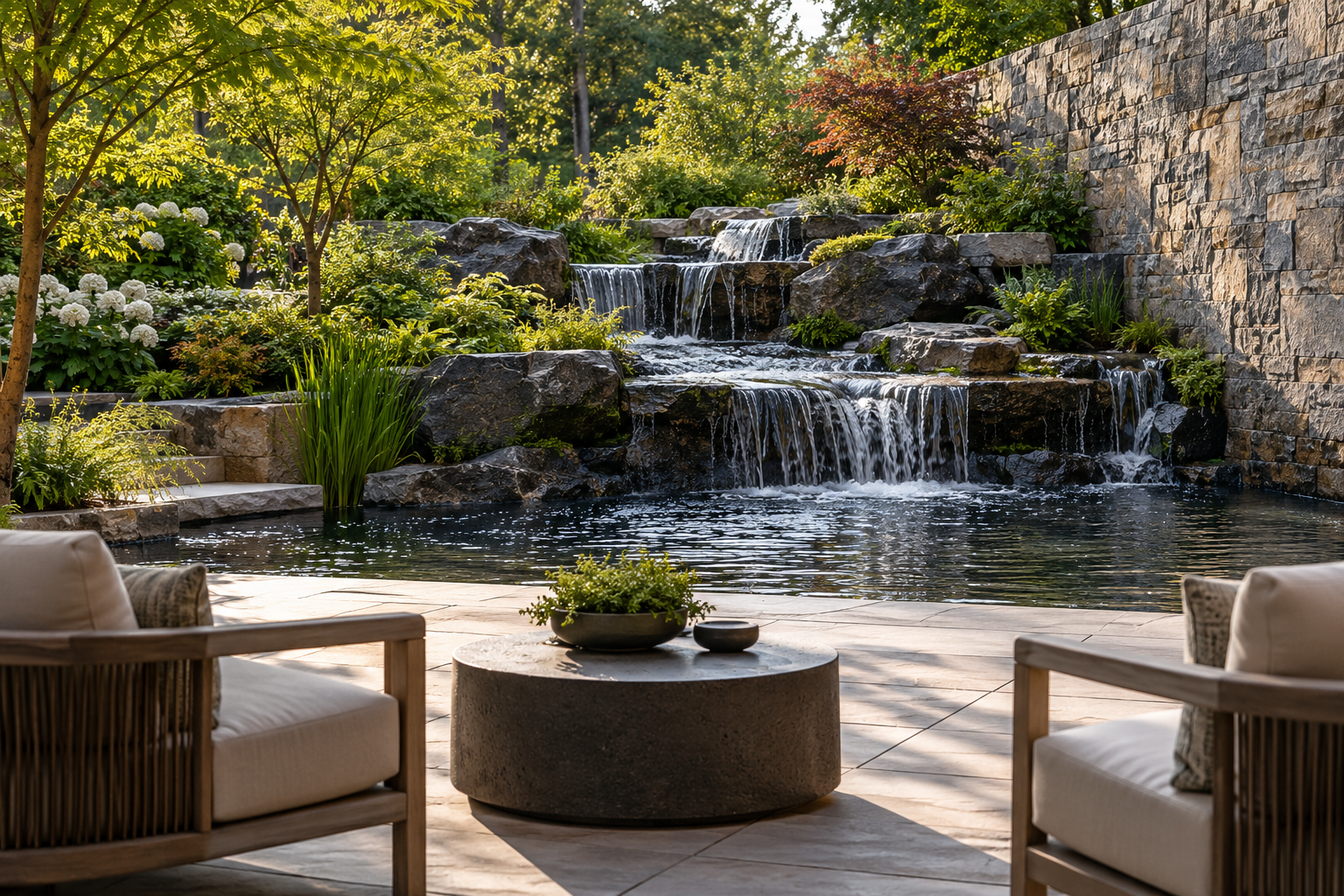
The waterfall looks gentle from the path, but conversation becomes difficult beneath the grotto roof. Across the garden, the same water sounds like a distant murmur. Neither impression is wrong: the listener’s position and the surrounding surfaces are part of the sound.
Planning a grotto soundscape means separating three things that a video often blends together: the water’s impacts, the enclosure’s response, and the mechanical background. Once those are distinguished, it becomes easier to decide whether the desired experience is a lively water feature, a conversational retreat, or a quiet place with only a trace of moving water.
A: Height alone does not determine the result; flow, impacts, enclosure, and distance also matter.
A: Roughness alone does not establish useful absorption.
A: No. Visual softness is not an acoustic performance specification.
A: Microphones, recording processing, and playback conditions affect the result.
A: No. Listen from the intended seats and other affected locations.
A: Yes. Separate mechanical tones from water impacts during assessment.
A: No. Formal numerical assessment requires suitable methods and equipment.
A: It can change the listener's relationship to the source and reflections.
A: Changes should remain within the designed hydraulic operating conditions.
A: Describe what people should be able to do comfortably while the feature operates.
Listen for the event that creates the sound
Waterfall sound is not one uniform ingredient. Water meeting a basin, striking a ledge, breaking into droplets, and disturbing an already moving surface produces a mixture of events. The rock profile and receiving area help determine where those events occur.
Instead of describing a concept only as a high or low waterfall, identify its principal impacts. A single free fall into a basin has a different pattern from a sequence of small steps. Neither description alone establishes which will be quieter in a particular grotto. The amount and distribution of water, landing geometry, and listener position all matter.
This is why a catalog video is useful for character but limited for comparison. Microphone placement, recording levels, compression, and playback volume influence what you hear. Two videos cannot reliably rank two waterfalls by loudness unless their recording and playback conditions are controlled.
The grotto changes what reaches the listener
Hard enclosing surfaces reflect sound. In a grotto, the direct sound from the waterfall can combine with reflected sound from walls and the ceiling. An open terrace and a deep recess beside the same feature therefore need separate evaluation.
Irregular rock texture should not automatically be treated as sound absorption. A surface can scatter reflections while remaining acoustically hard. Likewise, a little planting at the entrance does not establish that a space will be quiet. If speech comfort is central to the project, acoustic design deserves more than a visual assumption about soft-looking greenery.
Shape and openness matter too. The location of the entrance, the depth of the recess, and the position of seats change the relationship between listener, source, and reflecting surfaces. Moving a seat may alter the experience without changing the waterfall itself.
Distinguish water from machinery
A low hum, vibration, rattle, or intermittent mechanical tone may come from equipment rather than the falling water. If those sounds are bundled together as “waterfall noise,” a change to the rock face may leave the real problem untouched.
During a controlled commissioning or assessment process, the responsible team can compare operating conditions and identify likely sources. Equipment mounting, enclosure design, plumbing, and service condition may need attention. The solution should follow the identified source rather than assuming that more water will mask everything undesirable.
Choose the listening place before the signature sound
For a conversation grotto, evaluate the normal seating arrangement with people speaking at an ordinary level. The question is whether the intended activity feels comfortable, not whether the waterfall sounds impressive when everyone remains silent.
For a dramatic arrival sequence, a stronger water presence may be welcome along the approach, while a quieter seating pocket sits farther away. This separates two experiences instead of asking one location to provide both intensity and calm.
For a resort setting, nearby guest rooms, neighboring terraces, and operating hours belong in the brief. A pleasant daytime feature can have a different effect late at night when other background sounds diminish. Do not judge the project only during its busiest daytime period.
Run a listening comparison with repeatable conditions
- Mark the intended seats, approach, property edge, and any nearby indoor listening locations.
- Record which water effects and equipment are operating.
- Listen at each position for water impact, reflected sound, and mechanical tones separately.
- Compare conversation and quiet occupation where those are intended uses.
- Repeat under relevant operating conditions rather than relying on one brief visit.
Recordings can help preserve the character of a comparison when made consistently. They do not replace calibrated measurements where numerical criteria, exposure, or regulatory compliance must be assessed. A phone’s automatic processing can change the apparent balance between background sound and the waterfall.
Adjust the source, the path, or the receiver
| Part of the problem | Design direction to explore |
|---|---|
| Water impact | Review the flow pattern and receiving geometry |
| Mechanical tone | Investigate equipment, mounting, and service conditions |
| Enclosure response | Review geometry and suitable acoustic treatment |
| Listener location | Reconsider seating position and orientation |
| Time of use | Coordinate operating schedules with surrounding uses |
Any change to flow should remain within the designed hydraulic operating conditions. Turning equipment down arbitrarily can affect the intended effect or system operation. Likewise, acoustic finishes in wet settings need appropriate durability and maintenance characteristics; an indoor treatment cannot simply be attached to a damp rock ceiling.
A successful soundscape has a clear purpose. It may announce arrival, accompany conversation, or create a sense of separation from the surrounding garden. Define that purpose in ordinary terms, test it where people will actually be, and let the water’s sound support the place.
Related Articles

Sheet, Cascade, or Segmented Flow? Choosing a Grotto Waterfall
Choose sheet, cascade, or segmented grotto waterfalls by comparing water shape, splash, sound, viewing distance, and upkeep.
Lighting a Grotto Without Losing the Shadows
Plan grotto lighting with readable paths, selective rock accents, controlled glare, and shadows that preserve depth.
Resort Grottos That Feel Like Places: Seating, Privacy, and Guest Flow
Design resort grottos around guest arrival, seating choice, privacy, accessible circulation, service, and comfortable departure.