
Artificial Rock & Sculpted Concrete

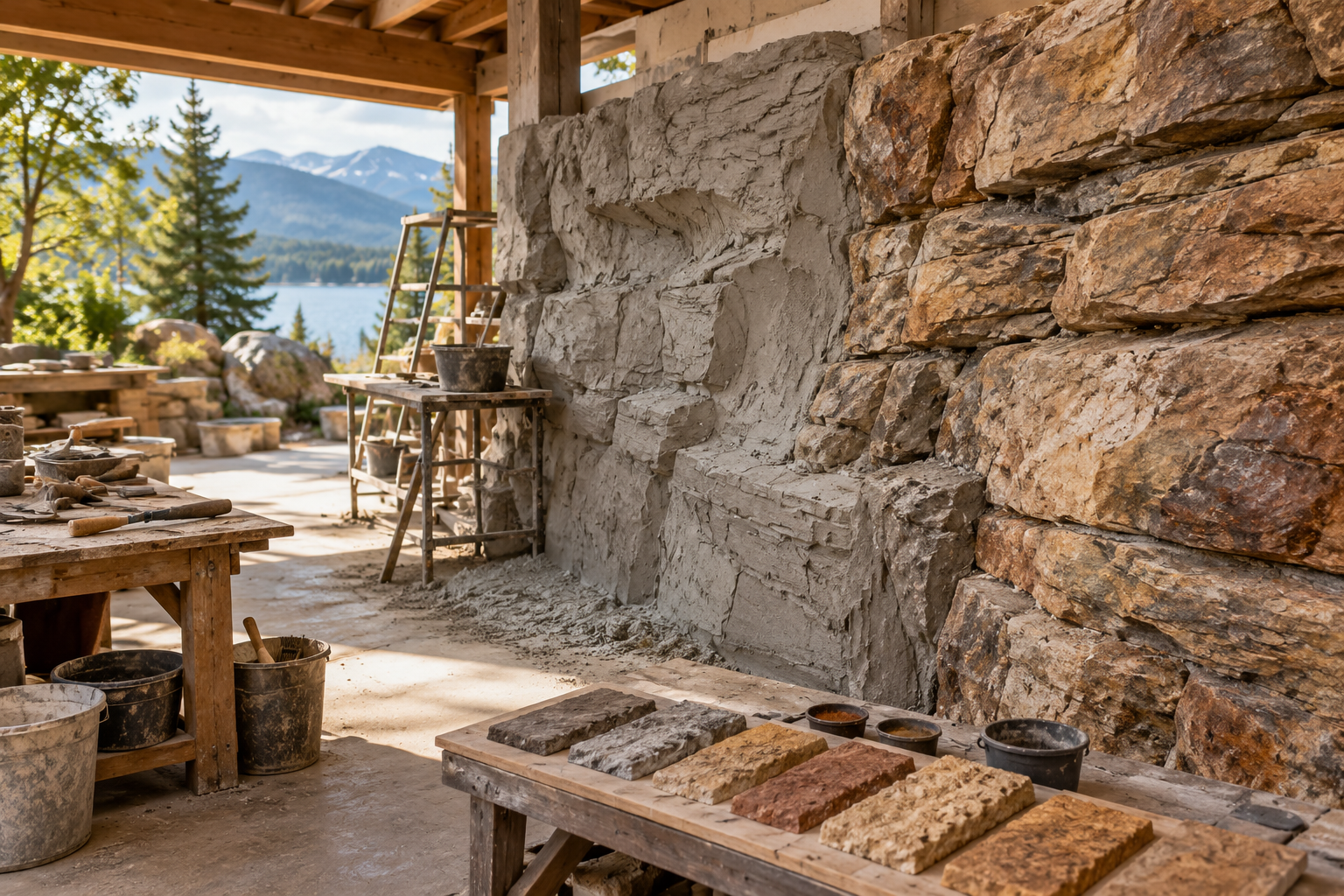
Illustration of unfinished and colored sculpted concrete rock surfaces

Artificial rock gives a designer control over forms that would be difficult to assemble from stone. An overhang, a continuous layered wall, or a carefully placed recess can be shaped around the intended space rather than discovered in a stockpile. That freedom makes visual discipline more important. Artificial Rock & Sculpted Concrete explores the process of turning a constructed surface into a convincing geological composition. Examine broad modeling, carved fractures, texture, coloration, joints, and the relationship between the scenic skin and its supporting assembly. The subject includes both hand-shaped work and surfaces informed by molds or natural references. It also considers why a sample must be judged at the distance and under the conditions in which it will be seen. Fine detail cannot compensate for an incoherent silhouette, and a realistic finish does not establish structural capacity or waterproofing. For owners, artists, and designers, this collection provides a way to discuss the craft accurately while keeping the separate technical roles visible. The result can be expressive scenery whose appearance and underlying construction remain thoughtfully coordinated.

Scenic skin: Separate appearance from structural support.
Massing: Establish large forms before texture.
Carving: Cut or model deliberate geological details.
Reference: Choose a coherent rock character.
Texture: Match detail scale to viewing distance.
Coloration: Support form rather than conceal poor geometry.
Joints: Integrate necessary assembly boundaries.
Mockup: Test a representative finished area.
Exposure: Specify the actual operating conditions.
Coordination: Scenic and technical work must align.
Continuous forms: Sculpting can connect broad surfaces.
Controlled openings: Geometry can follow the intended layout.
Handwork: Individual treatment introduces useful variation.
Molded detail: Repetition requires careful placement.
Wet appearance: Water changes color and sheen.
Lighting: Grazing light emphasizes carving depth.
Silhouette: Distant views reveal major form problems.
Substrate: The finish depends on its supporting system.
Repairability: Future matching deserves early consideration.
Documentation: Record materials and finish methods.
Clay studies: Develop massing before full-scale work.
Reference boards: Organize geological visual rules.
Carving tools: Select tools appropriate to the specified material.
Texture samples: Compare scale and directional character.
Color samples: Review under intended lighting.
Full-size mockups: Include joints and transitions.
Assembly sections: Identify hidden supporting layers.
Product data: Confirm material-specific requirements.
Photo records: Document stages before concealment.
Finish schedules: Preserve the approved visual standard.
Geological consistency: Related fractures make variation believable.
Scale control: Excessively fine texture can look miniature.
Surface hierarchy: Quiet planes strengthen selected details.
Assembly distinction: A rock-like finish may cover several systems.
Movement planning: Scenic treatment must respect functional joints.
Waterproofing separation: Decorative concrete is not a universal containment solution.
Craft sequencing: Timing affects how surfaces can be worked.
Sample representativeness: Include difficult transitions, not only easy centers.
Maintenance effect: Cleaning can alter coloration and texture.
Design restraint: Fewer convincing features can outperform dense ornament.
Carved shadows: Recesses create depth without dark paint.
False mass: A surface can suggest more thickness than it has.
Repeat recognition: Familiar mold patterns become noticeable over large areas.
Wet highlights: Moving water reveals otherwise quiet relief.
Handmade variation: Small differences can prevent mechanical repetition.
Big forms first: Rough models often communicate geology immediately.
Hidden seams: Natural breaks can inform joint placement.
Color layers: Subtle variation avoids a uniformly painted appearance.
View distance: Details disappear differently across a pool.
Scenic flexibility: Constructed forms can accommodate planned service openings.
Q: Is artificial rock always concrete?
A: No. Several material systems can create rock-like scenery.
Q: Does realistic appearance establish strength?
A: No. Structural performance requires separate design.
Q: Should every surface receive equal texture?
A: No. Visual hierarchy benefits from quieter areas.
Q: Can molds replace all handwork?
A: Their use depends on the intended result and assembly.
Q: Why make a large mockup?
A: Scale, joints, color, and lighting interact.
Q: Is a decorative finish automatically waterproof?
A: No. Water containment requires an appropriate system.
Q: Can joints be carved over indiscriminately?
A: Functional movement requirements must remain respected.
Q: How should coloration be reviewed?
A: Under representative lighting and exposure conditions.
Q: What records help repairs?
A: Material details, finish methods, and approved samples.
Q: What makes artificial rock convincing?
A: Coherent form, scale, texture, and context work together.
Latest Artificial Rock & Sculpted Concrete Articles