
Cave Formations & Minerals

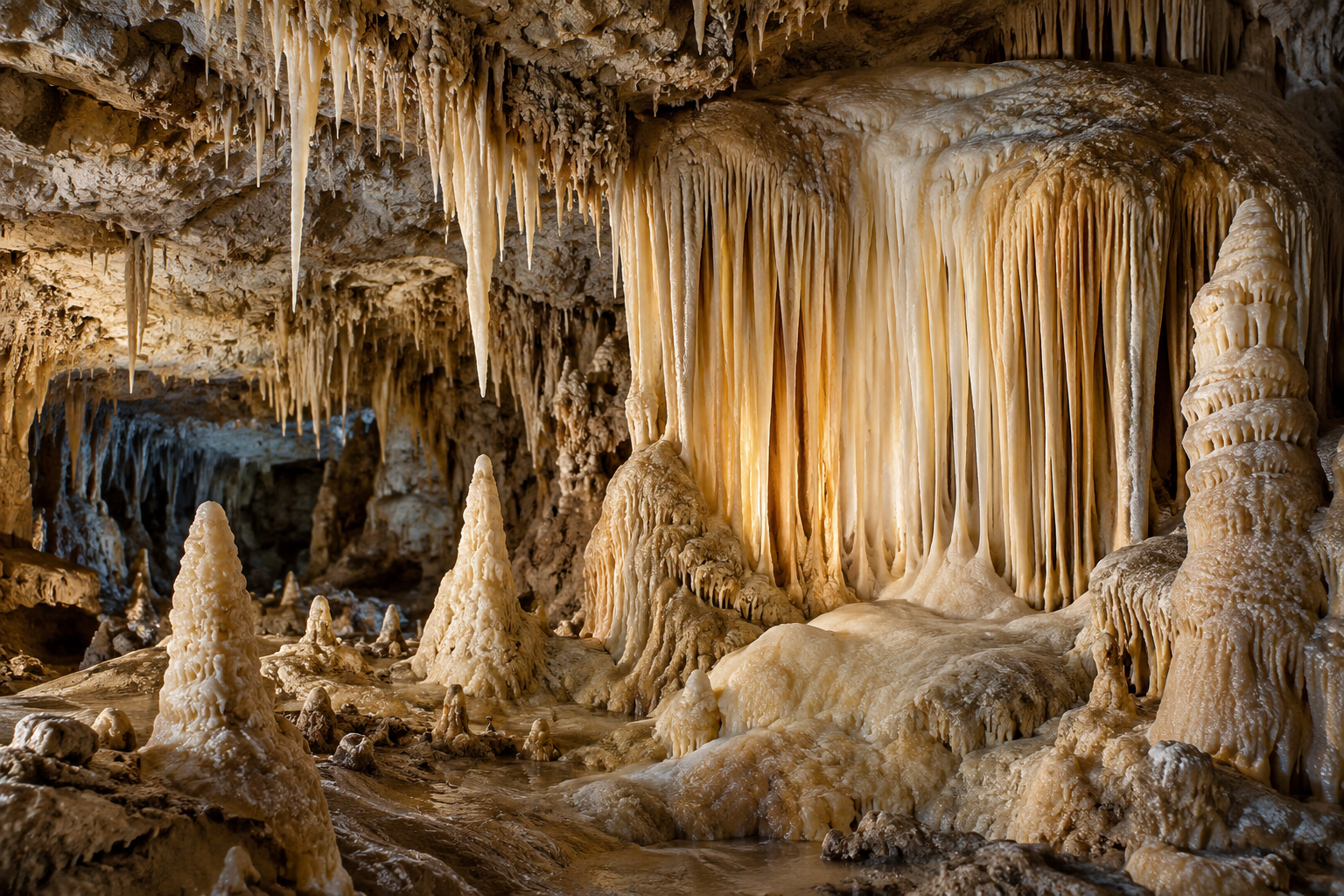
Illustration of stalactites, mineral curtains, flowstone, and stalagmites

A hanging curtain of calcite tells a different story from the chamber around it. The cave is an opening; its formations are deposits that can grow after that opening exists. Cave Formations & Minerals focuses on this second architecture, where small movements of mineral-bearing water produce striking differences in shape. Explore stalactites, stalagmites, columns, draperies, flowstone, and other deposits through their geometry and setting. Learn why a formation’s position matters, how a thin sheet differs from a massive coating, and why color alone is an unreliable mineral identification tool. The subject rewards close observation without contact: delicate surfaces can preserve information that damage removes. Readers interested in geology can connect familiar names with processes, while artists and grotto designers can build a more accurate visual vocabulary than a random collection of spikes. Photographs become more informative when they record scale, location, and neighboring features. Follow the path of water across a ceiling or down a wall, and the apparent ornament begins to reveal a history of deposition, interruption, and changing conditions within an existing cave.

Speleothem: A mineral deposit formed within a cave.
Stalactite: A formation hanging from above.
Stalagmite: A deposit growing upward from the floor.
Column: A joined formation connecting floor and ceiling.
Drapery: A thin hanging sheet following a sloping surface.
Flowstone: Mineral deposited as a coating by flowing water.
Calcite: A common mineral in carbonate cave formations.
Deposition: Dissolved material becomes solid mineral.
Water route: Flow position influences the developing shape.
Conservation: Fragile deposits should be observed without disturbance.
Cavity first: A hanging formation requires an existing open space.
Shape diversity: Similar minerals can produce very different forms.
Color complexity: Impurities and conditions can influence appearance.
Slow records: Deposits may preserve evidence of changing environments.
Interrupted growth: A formation need not grow continuously.
Thin structures: Some curtains are translucent under suitable light.
Floor counterparts: Drips can connect ceiling and floor deposits.
Coated history: New mineral can cover older surfaces.
Scale range: Formations vary from tiny details to substantial masses.
Identification limits: Photographs rarely establish every mineral property.
Formation guides: Compare terminology with illustrated geological references.
Location notes: Record which cave a photograph represents.
Non-contact photography: Capture details without touching the deposit.
Scale information: Use documented dimensions when available.
Directional lighting examples: Study how illumination reveals relief.
Mineral references: Distinguish mineral composition from formation shape.
Museum specimens: Examine authorized displays for closer study.
Image annotations: Mark ceiling, floor, and water-route relationships.
Research papers: Consult specialist work for dating or chemistry claims.
Design sketches: Simplify observed forms without inventing geological mechanisms.
Form and chemistry: Shape names do not automatically identify composition.
Drip placement: Small differences in water delivery can change geometry.
Surface flow: Sheets and coatings reflect water spread across a surface.
Growth histories: Deposits can contain layers formed under differing conditions.
Age distinction: Host rock, cave cavity, and formation have different histories.
Lighting bias: Strong color casts can conceal natural mineral appearance.
Overlapping deposits: One generation can partly obscure another.
Fragility: Fine structures may be damaged by seemingly minor contact.
Scenic restraint: Fewer well-placed formations can suggest a coherent cave.
Interpretive evidence: Context supports explanations that an isolated close-up cannot.
Soda straws: Slender tubular formations can hang from cave ceilings.
Stone curtains: Draperies can resemble folded fabric.
Meeting points: A floor deposit and ceiling deposit may join.
Rippling coats: Flowstone can suggest frozen movement.
Unexpected angles: Some specialized formations depart from simple vertical shapes.
Mineral layers: A single feature can record several growth episodes.
Hidden scale: Close-up details may resemble much larger landscapes.
Soft silhouettes: Backlighting can emphasize a curtain's thin edge.
Repeated drips: Small water deliveries can contribute to substantial deposits over time.
Unfinished surfaces: Not every cave chamber is richly decorated.
Q: Which hangs down, a stalactite or stalagmite?
A: A stalactite hangs from above; a stalagmite grows upward.
Q: Is a formation the same age as its cave?
A: Not necessarily. Deposition occurs within an already existing cavity.
Q: Are all cave formations calcite?
A: No. Cave deposits can contain different minerals.
Q: Can color identify a mineral reliably?
A: Color alone is insufficient for a dependable identification.
Q: What is flowstone?
A: It is a mineral coating deposited by water moving across a surface.
Q: How does a column form?
A: In some cases, a stalactite and stalagmite meet and continue growing together.
Q: Do formations grow at one universal rate?
A: No. Growth depends on local conditions and can be interrupted.
Q: Why avoid touching them?
A: Contact can damage fragile structures and protected surfaces.
Q: Can artificial formations reproduce the visual effect?
A: They can interpret the shapes, but they do not share the geological history.
Q: What makes a formation photograph informative?
A: Location, scale, orientation, and surrounding features provide valuable context.