
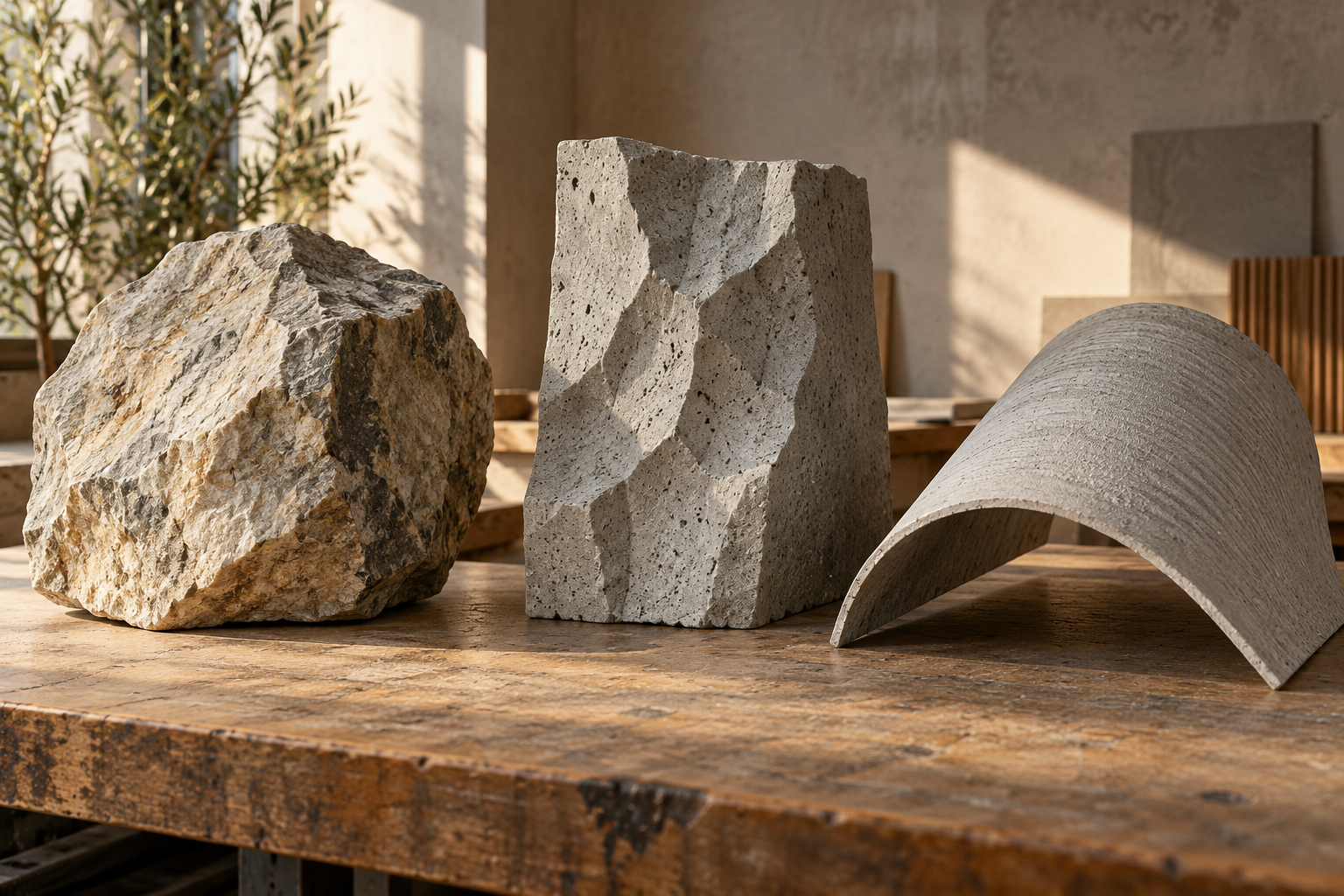
Rockwork is both a surface and a system. A natural boulder, a sculpted cementitious finish, and a molded GFRC panel may resemble one another from across a pool, yet arrive on site, connect to their supports, and age in different ways. Comparing only their finished color misses most of the decision.
For a grotto, the useful comparison follows the material from its visible face to what holds it in place. That exposes the real choices: geological character, freedom of shape, assembly weight, joints, access, and the ability to repair a specific surface years later.
A: No. It is a glass-fiber-reinforced cementitious material.
A: Its role depends on the engineered assembly; do not assume it does.
A: Realism also depends on selection, orientation, scale, and composition.
A: A visual finish cannot remove the need to resolve movement and interfaces.
A: Supports and attachments add to the weight of the visible material.
A: Yes, when the finished rockwork will regularly be seen wet.
A: Obvious repetition of distinctive features can reveal the pattern.
A: Keep product records, finish samples, photographs, and relevant fabrication information.
A: Yes, with deliberate design of their supports and interfaces.
A: None; access, geometry, fabrication, support, and finishing change the project cost.
Start by separating appearance from structural duty
The phrase “rock grotto” does not tell you what supports the roof. Natural stone may be used as individual masses, as facing, or as part of a designed masonry assembly. Sculpted concrete may form a finish over a supporting framework. GFRC may be fabricated as relatively thin panels connected to a separate support system. None of those descriptions alone establishes the capacity of a completed structure.
A useful proposal identifies the visible material, supporting assembly, connections, and water-management approach separately. This prevents an attractive sample from becoming a substitute for the information needed to evaluate the whole grotto.
Natural stone brings variation that cannot be ordered by paint code
Natural stone offers mineral texture, weathering, bedding, fractures, and irregularity. Those qualities can make a composition convincing at close range. They also mean that selecting a general stone name is only the beginning. Two deliveries bearing the same broad description may differ in shape, color range, and the faces available for display.
Review actual representative pieces and how they will be oriented. A broad flat face may suit a ledge, while a rounded mass may work better as a foreground boulder. The setting matters too: a stone that looks restrained when dry may darken strongly when wet. Evaluate it under the conditions in which visitors will see it.
Transport, handling, and support can become major parts of the design. A large stone’s visual simplicity does not make its placement simple. Ask how the selected pieces reach their positions and how replacements would be approached if one later becomes unsuitable. These questions belong to the project team rather than to an assumed rule about “real rock.”
Sculpted concrete offers continuity and site-specific shape
Sculpted cementitious rockwork allows a surface to be shaped around the intended space. Strata, recesses, ledges, and transitions can be composed together, which is useful when the grotto must fit a particular footprint. The result depends on both the assembly design and the craft used to form and finish the visible surface.
Large uninterrupted-looking surfaces still need a strategy for movement, joints, and changes in substrate. A finish that visually disguises a junction does not eliminate the behavior beneath it. Ask where joints occur, how they are expressed, and how water is kept from reaching vulnerable parts of the assembly.
Color should be evaluated as a layered effect rather than a single swatch. Base color, stains, washes, texture, and shadows may all contribute. Retain a finished reference sample and the actual product records. A future repair will need to match the assembled appearance, not merely a name such as desert sandstone.
GFRC separates a molded face from much of the bulk
Glassfibre reinforced concrete, also called glass fiber reinforced concrete or GRC, uses alkali-resistant glass fibers in a cement-based matrix. It can be made in thin sections and reproduce detailed molds. That combination makes it useful where a rock-like face is wanted without reproducing the full mass of the natural form.
The panel is only one part of the installed assembly. Supports, anchors, joints, backing, and access provisions still contribute to weight, cost, and complexity. Compare complete assemblies rather than a panel weight against the weight of a solid boulder.
Molded surfaces can carry convincing geological detail, but repeated pieces need thoughtful arrangement. Reusing the same distinctive crack or protrusion in an obvious rhythm can reveal the fabrication method. Rotation, transitions, and varied finishing can help a composition read as a larger formation rather than a collection of repeated panels.
Use a comparison that includes the hidden work
| Question | Natural stone | Sculpted concrete | GFRC rockwork |
|---|---|---|---|
| Where does the visible character originate? | The selected geological material | On-site shaping and finishing | Mold detail, assembly, and finishing |
| What needs early coordination? | Piece selection, handling, and support | Substrate, shaping access, and joints | Panel layout, connections, and seams |
| What helps later repair? | Stone identification and spare matching material | Finish records and retained samples | Panel records, mold information, and finish records |
Compare samples at the scale of the decision
A hand sample can answer a color question. It cannot show whether a repeated panel pattern will look convincing across a grotto roof. A larger mockup can include a corner, joint, recess, and wet surface, revealing relationships that separate samples omit.
Choose a viewing distance appropriate to the project. Visitors may touch a wall beside a seat while seeing the roof only from several steps away. Allocate detail accordingly. A heavily textured sample can look impressive on a workbench yet produce an overly busy interior when repeated across every surface.
The best choice may combine methods
A project might use selected natural stones at the ground, sculpted transitions around them, and fabricated panels elsewhere. Such combinations need deliberate interfaces so differences in movement, finish, and moisture exposure are addressed. The aim is not to make every material perform every role.
Request a proposal that explains why each material occupies its particular location. That explanation is more useful than an absolute claim that one method is always most realistic, cheapest, or maintenance-free. A convincing grotto comes from coordinated choices about the complete assembly and the experience at its surface.
Related Articles
Waterproofing a Grotto: Where Water Gets In and How Assemblies Manage It
Understand grotto waterproofing by tracing rain, splash, plumbing, groundwater, and condensation through the complete assembly.
A Grotto Inspection Walkthrough: Changes to Notice and Record
Build a useful grotto inspection record with repeatable photographs, clear observations, water-pattern notes, and follow-up.
How Limestone Caves Form: The Water-Shaped Architecture Underground
Follow the water to understand limestone cave formation, karst drainage, passage shapes, and the mineral deposits that decorate caverns.