
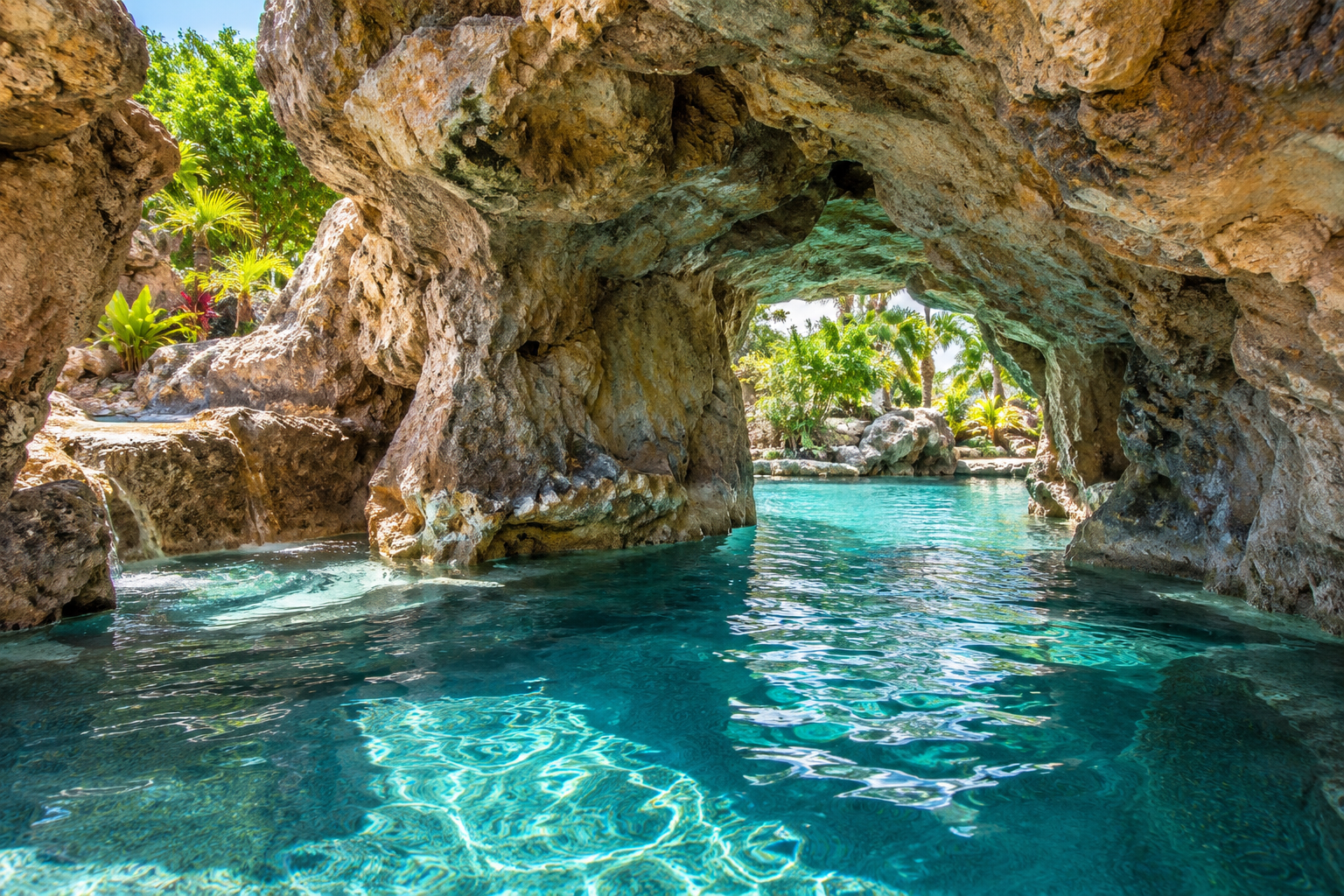
Passing beneath a rock arch can make a pool feel like a sequence of connected places. The attraction lies in movement: one opening leads toward another, light changes overhead, and the swimmer emerges into a different view. Swim-Through Grottos focuses on that connecting role rather than on enclosed lounging spaces. Explore the geometry of open passages, the relationship between entrances, and the ways rockwork, water, and lighting influence orientation. A scenic tunnel must also be considered as part of an operating aquatic environment, with visibility, supervision, circulation, and access addressed by the project team. The collection helps owners and designers ask better questions about a concept that photographs can easily oversimplify. An image taken directly through an opening may hide side recesses, overhead projections, or competing movements. Compare the passage from both approaches and from the surrounding pool deck. The aim is an understandable transition with a clear purpose in the larger layout, where the sense of discovery comes from changing scenery rather than uncertainty about where the route continues or how the space works.
A: No. Its primary role is connecting areas through movement.
A: Yes. Arrival, visibility, and movement differ at each end.
A: No. Project-specific professional assessment is necessary.
A: No. Side areas, overhead form, operations, and other conditions also matter.
A: They can change visibility, sound, and orientation.
A: They represent important operational views beyond the swimmer's perspective.
A: The design and operating plan must consider interactions with through movement.
A: Its connections and operations require a whole-pool perspective.
A: Yes. Temporary unavailability can affect surrounding use.
A: A coherent change in enclosure and view gives the route a clear experiential purpose.