
Drainage & Groundwater

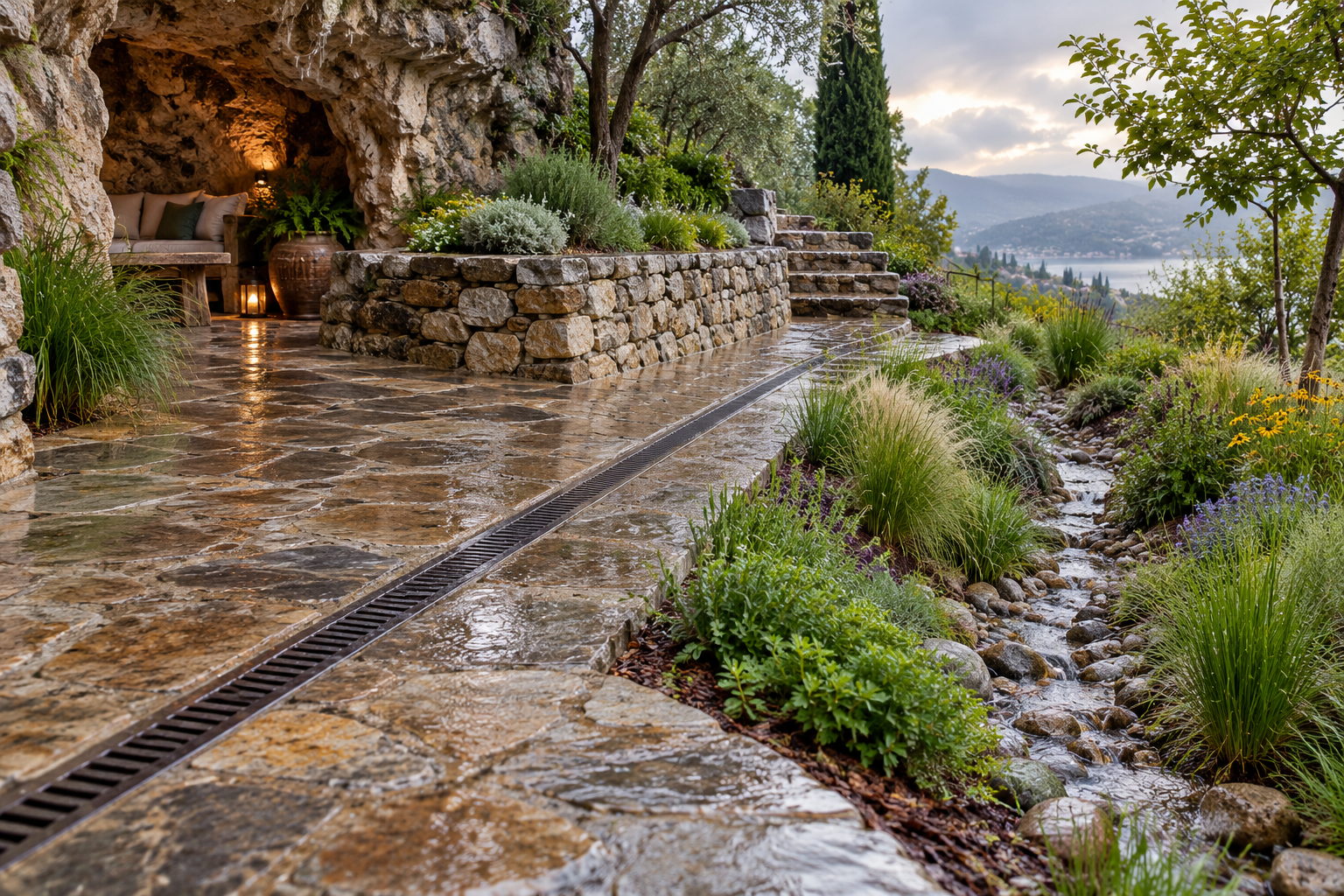
Illustration of a drain and planted swale beside a grotto terrace

Water that belongs in a grotto feature should have a different route from water arriving unexpectedly from the surrounding site. Rainfall, surface runoff, groundwater, splash, and maintenance water can meet near the same rockwork while requiring different responses. Drainage & Groundwater explores that distinction at the scale of the setting. Follow the relationship between slopes, collection points, concealed routes, outlets, and the areas downstream. A drain is not a complete solution unless the water has somewhere appropriate to go, and a dry photograph says little about conditions during a storm. This collection introduces the information needed to discuss site water with designers and specialists, including existing patterns, seasonal observations, and the limits of surface inspection. It also examines access for cleaning, the effects of debris, and the way decorative rock or planting can unintentionally obstruct a working route. For projects near existing structures or changing ground conditions, investigation matters more than a detail. Begin with the wider landscape, then trace how the grotto alters water movement across, around, and beneath its proposed footprint over time.

Runoff: Surface water follows the site geometry.
Groundwater: Subsurface water requires separate consideration.
Collection: Identify where water gathers.
Conveyance: Routes carry collected water onward.
Outlet: The destination is part of the system.
Grade: Levels influence surface movement.
Debris: Obstructions can change performance.
Access: Collection points need maintainable arrangements.
Existing patterns: Understand conditions before proposing changes.
Investigation: Concealed ground conditions may require specialists.
Multiple sources: Rain, splash, and groundwater differ.
Storm conditions: Dry-weather observations are incomplete.
Downstream effects: Moving water elsewhere still creates responsibilities.
Plant growth: Vegetation can obstruct access or routes.
Rock projections: Scenic geometry can redirect runoff.
Maintenance water: Cleaning adds another operating condition.
Seasonal variation: Ground conditions can change over time.
Existing structures: Nearby construction affects the design context.
System records: Hidden routes need accurate documentation.
Complete path: A collection point alone is not a drainage strategy.
Topographic survey: Establish relevant levels and slopes.
Wet-weather notes: Record observed water patterns.
Drainage drawings: Trace collection through final discharge.
Ground investigations: Resolve appropriate subsurface questions.
Outlet records: Identify the intended receiving location.
Maintenance maps: Locate cleanouts and collection points.
Photographic logs: Compare conditions across dates.
Landscape plans: Coordinate planting and rockwork.
Professional assessments: Address project-specific site-water issues.
As-built information: Preserve installed route details.
Source separation: Different water mechanisms require different analysis.
Boundary effects: A grotto can alter neighboring flow patterns.
Hidden uncertainty: Surface conditions cannot reveal every subsurface route.
Maintenance dependence: Debris can undermine an otherwise planned system.
Outlet coordination: Capacity and destination require appropriate assessment.
Landscape interaction: Planting and grading are part of water management.
Construction changes: Temporary works can affect drainage too.
Long-term access: Finished scenery must not prevent routine care.
Observation limits: One storm does not describe every possible condition.
Whole-site perspective: Local fixes need to fit the broader drainage plan.
Invisible routes: Water may move beneath apparently dry ground.
Seasonal clues: Persistent wet patches can vary through the year.
Small barriers: A modest rock edge can redirect runoff.
Leaf effects: Planting contributes debris as well as atmosphere.
Quiet outlets: Discharge locations may be far from the grotto.
Changing grades: Small level differences matter to surface flow.
Hidden maintenance: Cleanouts are practical parts of the landscape.
Different waters: Decorative circulation is not site drainage.
Photographic history: Repeated views reveal patterns missed in one visit.
Landscape continuity: Water connects the feature with areas beyond its boundary.
Q: Is splash drainage the same as groundwater control?
A: No. They involve different sources and conditions.
Q: Does adding a drain guarantee success?
A: No. The complete route and outlet must work.
Q: Can a dry site photograph rule out water problems?
A: No. Conditions vary with weather and season.
Q: Why preserve cleanout access?
A: Routes may need inspection and debris removal.
Q: Can planting affect drainage?
A: Growth and debris can alter access and flow.
Q: Should nearby structures be considered?
A: Yes. The grotto belongs within a wider site context.
Q: Can groundwater be assessed visually alone?
A: Often not; appropriate investigation may be needed.
Q: Why document the outlet?
A: Water needs an identified appropriate destination.
Q: Does construction staging matter?
A: Temporary conditions can change water movement.
Q: What is the starting point for planning?
A: Understand existing sources, levels, routes, and uncertainties.