
Underwater & Waterfall Lighting

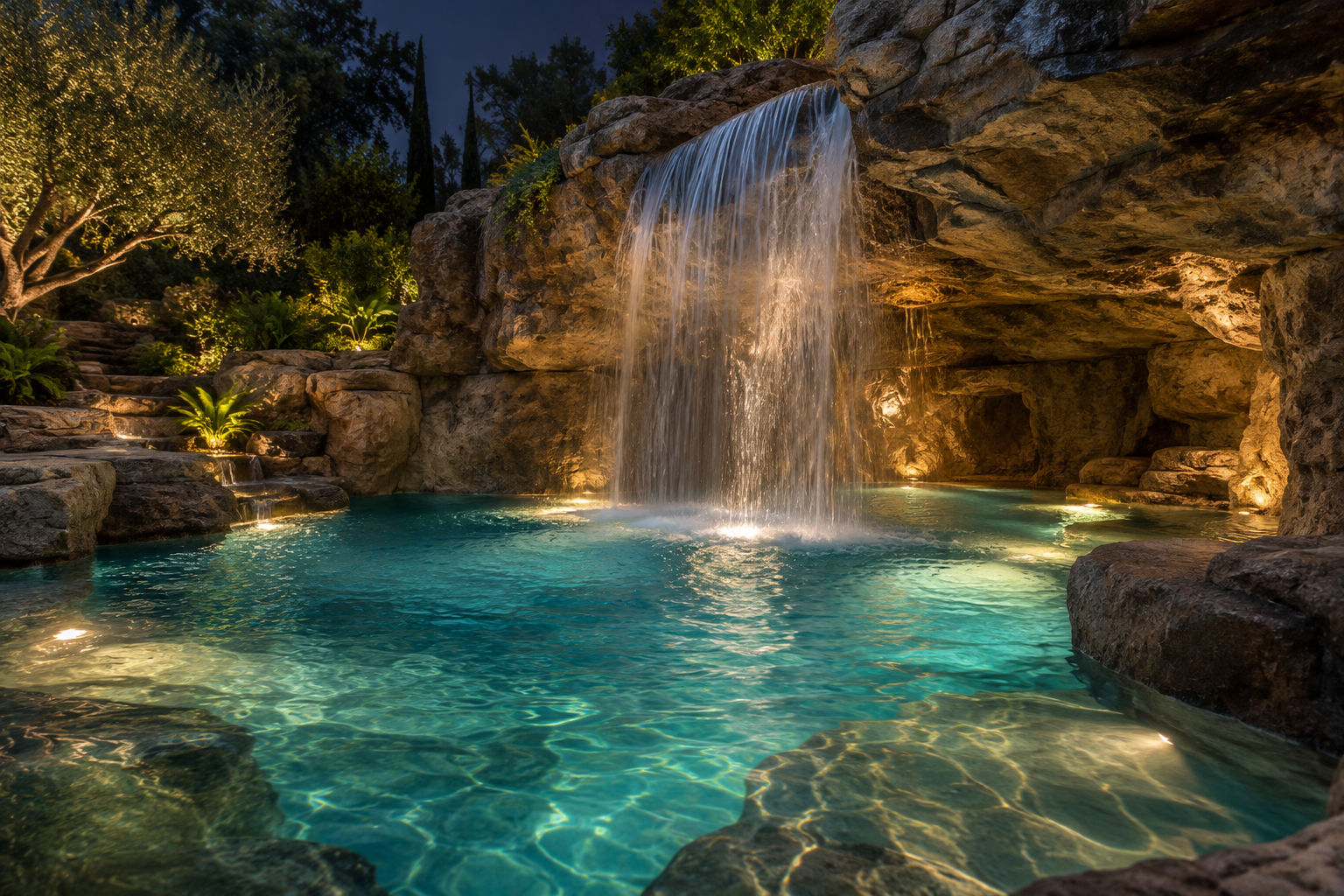
Concept illustration of a grotto waterfall and turquoise pool at night, subtle submerged lighting illuminating water and soft light catching the falling veil

Illuminating water means working with movement, reflection, and changing surfaces. A fixture beneath a pool can send rippling patterns onto a ceiling, while light aimed at a waterfall may reveal a bright veil from one angle and almost nothing from another. Underwater & Waterfall Lighting examines those effects around grottos and aquatic landscapes. Compare the appearance of submerged surfaces, falling sheets, broken cascades, and the rock receiving their reflections. The collection emphasizes viewpoints because a source that looks discreet from the deck may become conspicuous from the water. It also considers the relationship between decorative effects and the visibility needed for the intended aquatic use. Equipment selection, installation, electrical protection, and maintenance require qualified attention specific to the setting; a striking image cannot establish suitability. For owners and designers, the useful starting point is a clear description of what should be seen and from where. Build the visual concept around the water’s movement, then coordinate the fixtures, access, and controls so the intended scene can be operated and maintained throughout the life of the installation.

Submerged light: Equipment operates within the water environment.
Waterfall light: Falling water responds differently from solid surfaces.
Reflection: Light redirects from water and nearby materials.
Refraction: Light changes direction across material boundaries.
Glare: Bright sources can dominate aquatic viewpoints.
Movement: Ripples continually alter projected patterns.
Visibility: Decorative effects must coexist with intended use.
Suitability: Use equipment specified for the actual application.
Access: Maintenance needs affect installation design.
Coordination: Aquatic and electrical professionals resolve technical requirements.
Veil effects: A sheet changes appearance with viewing angle.
Cascade sparkle: Broken water creates many small highlights.
Ceiling patterns: Ripples can animate overhead rock.
Dark finishes: Surface reflectance affects perceived brightness.
Source position: Deck and water views differ.
Clear water: Appearance still depends on operating conditions.
Color choices: Saturated effects can obscure natural material tones.
Pump changes: Flow variation changes the lighting result.
Stopped feature: Inactive outlets may become conspicuous.
Service planning: Submerged equipment requires appropriate maintenance arrangements.
Fixture specifications: Confirm the exact intended application.
Aquatic drawings: Locate lights within the complete system.
Viewpoint diagrams: Include deck and water positions.
Moving-water mockups: Evaluate effects under representative flow.
Control descriptions: Separate useful operating scenes.
Finish samples: Review underwater surface appearance.
Access plans: Coordinate inspection and replacement.
Professional reviews: Address applicable electrical and aquatic requirements.
Operating records: Preserve settings and equipment details.
Video comparisons: Capture patterns that still images miss.
Dynamic composition: Water prevents the scene from remaining static.
Angle dependence: A successful effect may be highly viewpoint-specific.
Source concealment: Reflections can reveal otherwise hidden fixtures.
Visual competition: Too many bright effects reduce hierarchy.
System interaction: Water flow and lighting need joint evaluation.
Exposure distinction: Splash-rated equipment is not automatically submersible.
Maintenance continuity: Replacement should preserve intended optical performance.
Scene transitions: Quiet and active modes may need different settings.
Color perception: Water and surfaces influence the final appearance.
Use priority: Scenic impact should not obscure practical aquatic needs.
Living ceilings: Ripples create moving light without moving fixtures.
Disappearing sheets: A waterfall can look transparent from one direction.
Silver fragments: Small droplets produce distinct highlights.
Color blending: Reflections combine with surrounding rock tones.
Changing patterns: Pump settings can alter projected movement.
Night depth: Lighting changes the perceived extent of water.
Hidden mirrors: Calm surfaces reveal bright sources elsewhere.
Soft animation: Gentle water movement can create subtle effects.
Dry contrast: Nearby unlit rock can strengthen water highlights.
Video value: Motion often explains the effect better than a photograph.
Q: Can garden lights be submerged automatically?
A: No. Equipment must be suitable for that specific installation.
Q: Why review views from the water?
A: They differ from poolside viewpoints.
Q: Does a waterfall look equally bright from every angle?
A: No. Its optical effect depends on geometry and lighting.
Q: Can pump settings affect illumination patterns?
A: Yes. Water movement changes the reflected and transmitted light.
Q: Should decorative lighting replace operational visibility?
A: The intended aquatic use must remain appropriately addressed.
Q: Why retain exact model information?
A: Replacement equipment may produce different effects or have different requirements.
Q: Can a photograph prove electrical suitability?
A: No. Technical specifications and qualified design are necessary.
Q: Is splash exposure equivalent to immersion?
A: No. These are different installation conditions.
Q: What should be mocked up?
A: Representative water movement, surfaces, and viewing positions.
Q: Who coordinates installation requirements?
A: Qualified aquatic and electrical professionals.