
Lava Tubes & Volcanic Caves

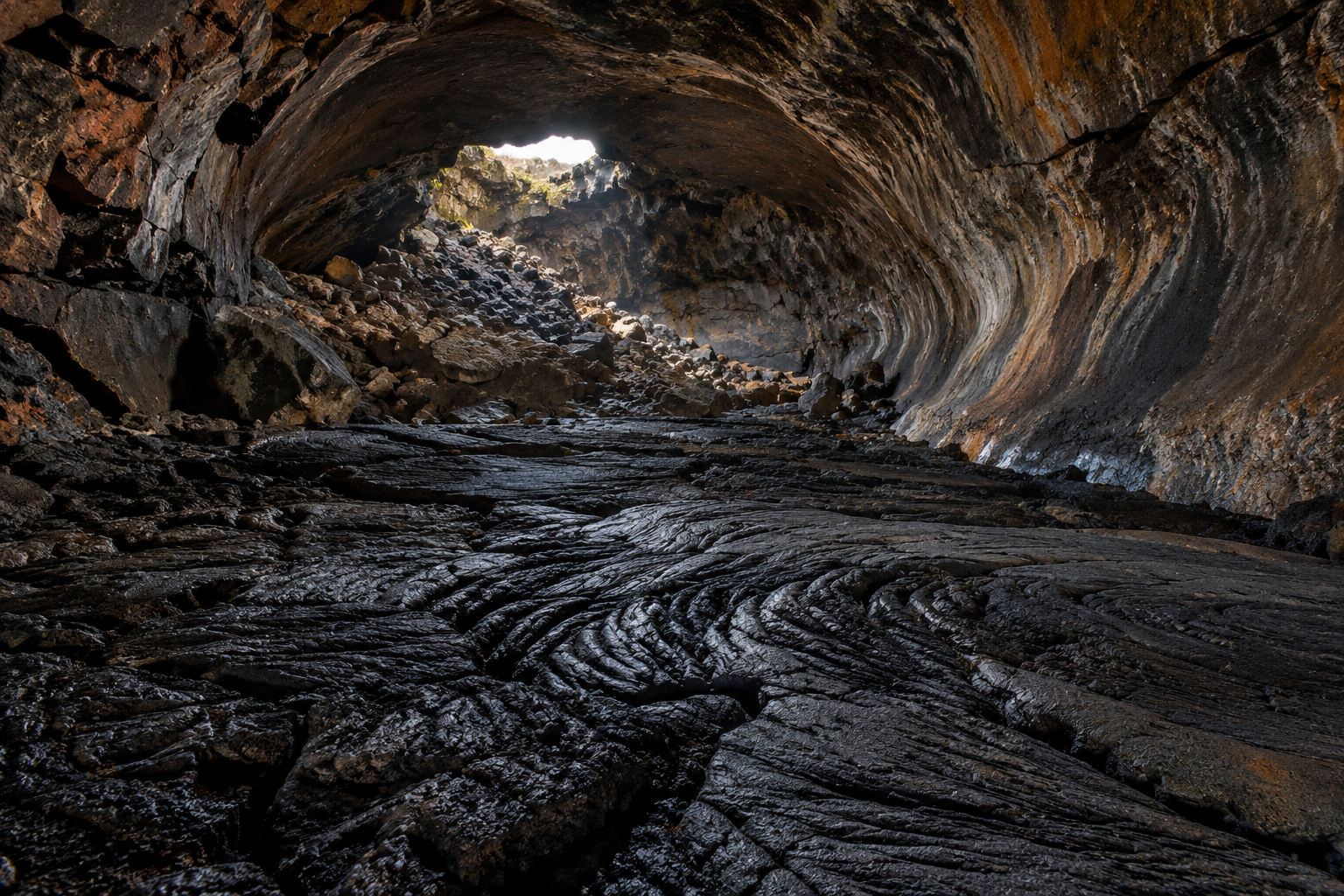
Illustration of a basalt lava tube with flow textures and a skylight

A tunnel left by flowing lava has an architecture shaped by heat and movement. Its roof may have insulated molten rock below, while its walls preserve traces of changing flow levels and cooling surfaces. When that moving interior drains away, an empty passage can remain. Lava Tubes & Volcanic Caves examines these spaces as records of volcanic activity rather than variations on a limestone cavern. Explore arched passages, skylights, benches, floor textures, and the relationship between an underground route and the lava field above it. The collection gives geology readers a starting point for interpreting volcanic cave forms and helps scenic designers recognize a distinct family of rock references. Dark basalt, smooth linings, broken crust, and overlapping flows can create powerful compositions without relying on mineral curtains or columns. Different volcanic settings produce different results, so location and documented history matter more than a dramatic image. Follow the evidence of molten movement, cooling, drainage, and later change to understand why a lava tube looks and feels different from a cave shaped primarily by dissolving rock.

Tube formation: A crust can enclose lava that continues flowing beneath it.
Drainage: An emptied flow route can leave a tunnel.
Basalt: Many familiar lava tubes occur in basaltic lava fields.
Insulation: A roof changes how an enclosed flow loses heat.
Flow levels: Wall markings can reflect changing lava conditions.
Skylights: Openings expose portions of an underground tube.
Cooling textures: Solidification leaves distinctive surfaces.
Passage branching: A lava system may contain interconnected routes.
Later change: Collapse, sediment, and water can modify volcanic passages.
Surface connection: Interpret the cave alongside its surrounding lava field.
Volcanic origin: Lava tubes form through processes different from limestone dissolution.
Variable dimensions: Tube size cannot be inferred from the entrance alone.
Dark surfaces: Basalt often absorbs much of the available light.
Multiple levels: Volcanic passage systems can be more complex than one tunnel.
Roof openings: A skylight is not necessarily the original flow entrance.
Floor history: Later flows may cover earlier passage surfaces.
Cold interiors: Some volcanic caves can contain persistent ice.
Fragile details: Small lava features can be vulnerable to damage.
Mapped extent: Surveyed passages represent documented accessible geometry.
Local variation: Different eruptions create different cave characteristics.
Volcanic maps: Relate cave locations to mapped lava units.
Park geology guides: Read explanations for the particular lava field.
Survey profiles: Compare changes in elevation along a tube.
Cross-section drawings: Study the relationship between roof and floor.
Reference photographs: Record lighting conditions to avoid misreading dark textures.
Image labels: Keep location and geological context with each example.
Scale models: Explore arched volumes without copying unsafe natural conditions.
Texture samples: Compare smooth flow-like surfaces with broken crust effects.
Museum displays: Use interpreted examples to understand volcanic terminology.
Access guidance: Follow the responsible land manager's current cave information.
Thermal story: A tube reflects the interaction between cooling and continuing movement.
Layered evidence: Successive lava surfaces can complicate a simple formation narrative.
Roof geometry: A passage's shape depends on its particular development history.
Drainage remnants: The final floor need not resemble the flowing lava's earlier surface.
Collapse interpretation: Openings can reveal construction history while removing older evidence.
Lighting challenges: Strong illumination may flatten dark surface relief.
Scenic coherence: Consistent flow direction makes volcanic-inspired rockwork more legible.
Material distinction: A black finish alone does not communicate volcanic geology.
Surface context: Overlying flow patterns can complement underground observations.
Conservation value: Undamaged details preserve evidence of volcanic processes.
Fire and ice: Ice can persist inside some lava caves.
Natural ceilings: Flowing rock can leave an enclosed route behind itself.
Wall shelves: Ledges may record former lava levels.
Skylight gardens: Daylight openings create conditions unlike the deeper tunnel.
Subtle colors: Basalt surfaces need not appear uniformly black.
Repeating arches: A passage can feel architectural without being constructed.
Small projections: Cooling lava can create delicate ceiling features.
Surface invisibility: A broad flow field may conceal a substantial tunnel.
Unexpected junctions: Lava pathways can branch and reconnect.
Visual contrast: A bright skylight emphasizes the surrounding darkness.
Q: Are lava tubes carved by underground rivers?
A: Their primary formation involves lava, though water can affect them later.
Q: Does every lava flow contain a tube?
A: No. Tube formation depends on suitable flow and cooling conditions.
Q: Why can a lava tube remain hollow?
A: Molten lava can drain from an enclosed route.
Q: Is every volcanic cave a lava tube?
A: No. Volcanic settings can contain other kinds of cavities.
Q: Can lava tubes contain ice?
A: Yes, where local conditions allow ice to persist.
Q: Are dark cave walls enough to identify a lava tube?
A: No. Geological context and documented evidence matter.
Q: What is a skylight?
A: It is an opening through the roof into the passage below.
Q: Why avoid touching delicate lava features?
A: Contact can damage formations that preserve volcanic history.
Q: How should a designer reference volcanic caves?
A: Study flow forms and textures, not merely dark coloration.
Q: Which drawings explain a tube best?
A: Plans, profiles, and sections reveal complementary aspects of its geometry.