
Streams & Cascades

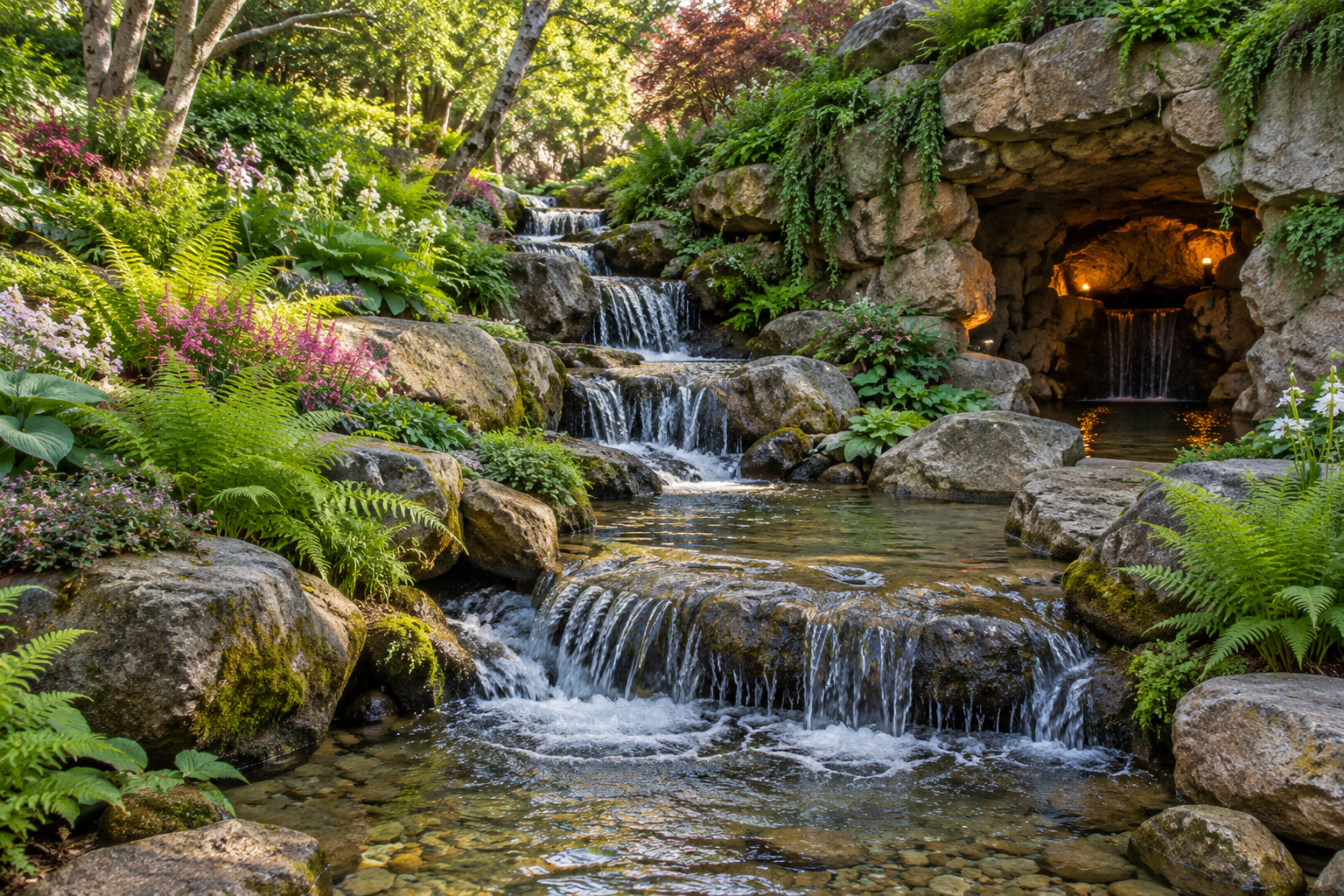
Illustration of a garden stream cascading toward a grotto

A small stream can give a grotto a beginning beyond its entrance. Water appears among planting, crosses a series of stones, and leads the eye toward a sheltered pool or darker recess. Streams & Cascades explores these connected routes, where movement unfolds across a landscape rather than in one dramatic drop. Examine channels, stepped descents, quiet reaches, receiving pools, and the transitions that make a constructed watercourse feel coherent. The shape of each contact matters: a broad shallow run produces a different impression from a narrow spill between rocks. Sound also changes along the route, offering opportunities to create active focal points and quieter places nearby. For garden owners and designers, the collection emphasizes the relationship between visible water and the systems that support it. Return paths, splash, debris, access, and the inactive appearance belong in the concept from the beginning. Follow the stream as a continuous composition, considering where water seems to originate, how it passes through the planting, and how its final destination connects with the grotto and the garden around that place.

Source effect: Decide where the water appears to originate.
Channel: The visible route organizes movement through the landscape.
Drop: A level change creates a distinct water event.
Reach: A quieter stretch connects more active features.
Receiving pool: Water gathers after a descent.
Return route: Recirculating water needs a complete hidden system.
Splash: Movement affects surfaces beside the channel.
Debris: Leaves and sediment can alter the route.
Access: Routine care requires reachable edges and components.
Sequence: Individual cascades should contribute to one composition.
Narrow spill: A focused outlet creates a clear accent.
Broad run: Shallow movement can reveal underlying texture.
Stepped descent: Several drops extend the experience across distance.
Quiet pocket: Slower-looking areas offer visual contrast.
Planting frame: Vegetation can direct attention along the water.
Rock continuity: Consistent geology helps the channel feel connected.
Crossing relationship: Paths and water need deliberate coordination.
Dry mode: Empty channels remain visible when stopped.
Sound gradient: Different locations hear different parts of the stream.
Grotto destination: The final pool can anchor the route.
Longitudinal section: Show the full sequence of level changes.
Channel plan: Coordinate rock, planting, and adjacent paths.
Water tests: Evaluate intended movement with appropriate mockups.
Video notes: Record the rhythm of several connected drops.
Sound references: Compare quiet and active listening positions.
Finish samples: Examine visible surfaces when wet and dry.
Maintenance map: Identify debris collection and service points.
Hydraulic design: Coordinate supply and return requirements professionally.
Plant information: Match vegetation with actual splash conditions.
Operating schedule: Define when the stream will run.
Rhythm: Alternating activity and quiet can prevent visual monotony.
Apparent origin: A convincing source needs spatial context.
Scale coherence: Rock sizes should relate to channel width and water effect.
Splash accumulation: Several small events can affect a broad surrounding area.
Debris interaction: Planting choices influence maintenance patterns.
Return concealment: Hidden infrastructure should remain serviceable.
Inactive composition: A dry route should still belong in the garden.
Sound placement: Put louder events where they support intended use.
Edge integration: Channel borders connect aquatic and planted environments.
Whole-route testing: One successful drop does not validate the entire sequence.
Leading lines: A stream can guide the eye toward a grotto.
Miniature drama: A small drop can create a strong focal point.
Reflected leaves: Planting appears within moving water.
Stone rhythms: Repeated ledges can connect separate cascades.
Quiet intervals: Pauses make active drops more noticeable.
Changing voices: Sound differs above and below a cascade.
Dry sculpture: An inactive channel reveals its rock composition.
Hidden beginnings: Water can appear from a discreet planted recess.
Evening accents: Selective lighting can trace only part of the route.
Garden connections: A stream can link spaces that otherwise feel separate.
Q: Does every stream need a large waterfall?
A: No. Small level changes can create a complete composition.
Q: Why include quiet reaches?
A: They provide contrast between more active drops.
Q: Can planting increase maintenance?
A: Leaves and growth can affect access and water routes.
Q: Should the stream be designed with pumps off?
A: Yes. Its inactive appearance remains part of the garden.
Q: What does a longitudinal section explain?
A: It shows the sequence of elevations along the watercourse.
Q: Can one tested cascade predict the whole stream?
A: No. Interactions across the complete route also matter.
Q: Why map splash?
A: Nearby paths, finishes, and planting experience its effects.
Q: Is the return route optional?
A: A recirculating feature needs a complete water system.
Q: How can sound support the layout?
A: Place active and quieter effects in relation to nearby activities.
Q: What makes a stream feel coherent?
A: Consistent rock character, deliberate rhythm, and a clear destination connect its parts.