
Lighting & Acoustics Glossary

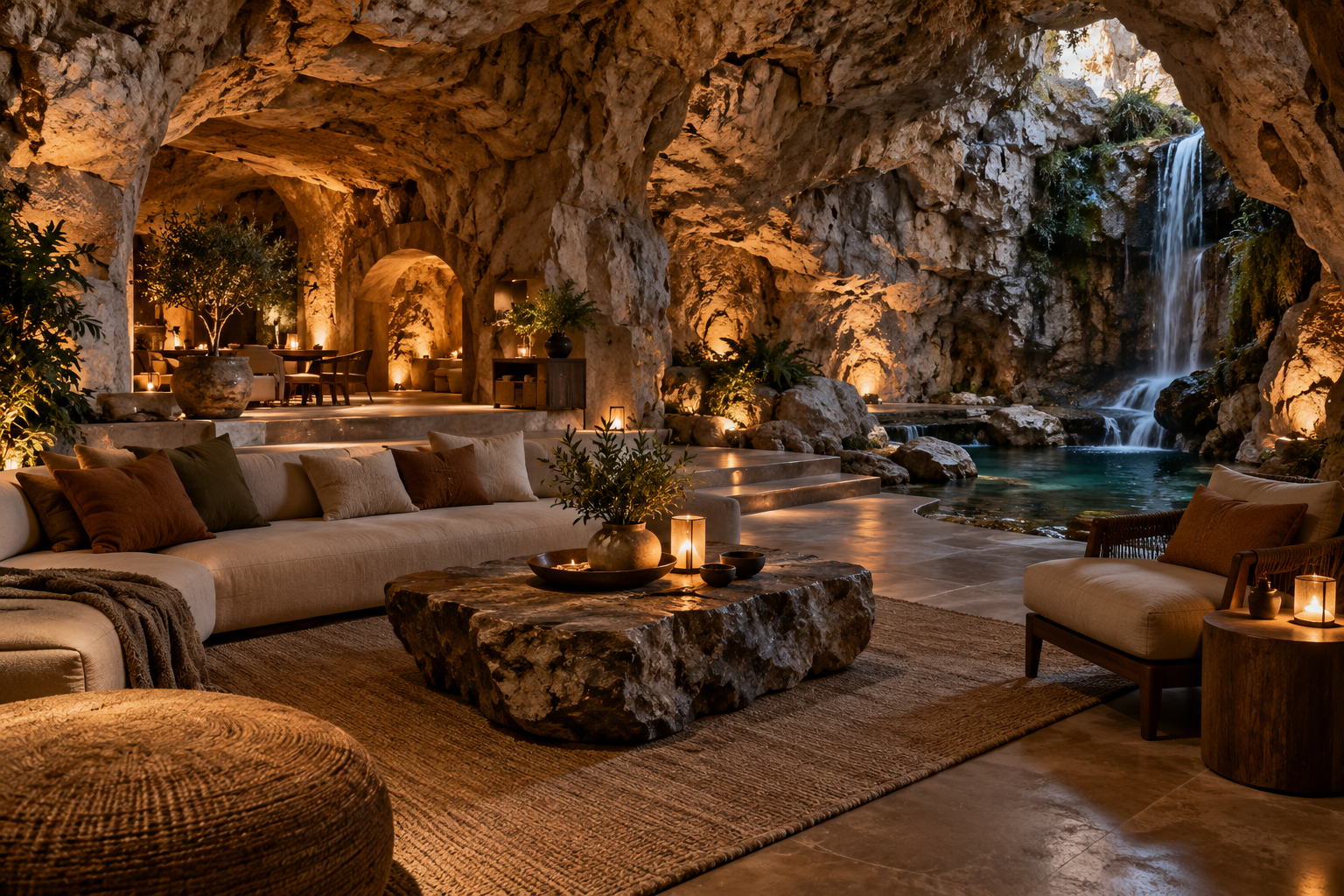
Concept illustration of a sophisticated artificial cavern lounge with warm grazing light revealing rock texture and a small calm water trickle far from seating, soft atmospheric shadows

Light and sound shape a grotto even when their sources remain unseen. A bright patch can draw attention across a chamber; a reflected sound can make an enclosure feel larger; glare can undermine an otherwise calm scene. The Lighting & Acoustics Glossary explains the vocabulary used to discuss those effects. It separates the quantity of light from its distribution, the appearance of a light source from its temperature in ordinary use, and a distinct echo from the persistence of sound through many reflections. These distinctions help readers describe an experience more accurately than simply calling it bright, dark, loud, or quiet. The reference also introduces fixtures, controls, acoustic treatments, measurement tools, and terms used in design reviews. A number on a product sheet needs context: where a measurement was taken, under what conditions, and how it relates to the intended activity. Readers can use these definitions to prepare a lighting or sound brief, interpret professional advice, and recognize when a scenic effect needs coordination with comfort, communication, maintenance, or the use of the surrounding space.

Lumen: A unit of luminous flux.
Illuminance: Light arriving on a surface per unit area.
Lux: One lumen per square meter.
Luminance: A measure of directional light from a surface.
Glare: Light causing discomfort or impaired visibility.
Color temperature: A descriptor of a light source’s color appearance.
Contrast: A difference between neighboring visual conditions.
Echo: A reflection heard as a distinct repeat.
Reverberation: Persistence of sound through multiple reflections.
Acoustics: The study and behavior of sound.
Luminaire: A complete lighting unit.
Beam angle: The specified angular spread of a light beam.
Grazing light: Illumination directed closely along a surface.
Wall wash: Broad illumination across a wall surface.
Ambient light: General surrounding illumination.
Accent light: Light emphasizing a selected feature.
Sound level: A measured quantity requiring its stated metric.
Frequency: Repetition rate of a vibration or wave.
Absorption: Conversion or loss of sound energy at materials.
Reflection: Return of light or sound from a surface.
Light meter: An instrument measuring specified lighting quantities.
Sound level meter: An instrument measuring defined sound metrics.
Dimmer: A control varying compatible lighting output.
Driver: Equipment providing suitable electrical operation for certain light sources.
Controller: Equipment coordinating programmed functions.
Acoustic panel: A treatment designed for specified sound behavior.
Diffuser: A device spreading light or scattering sound, depending on context.
Mockup fixture: A sample used to evaluate a proposed lighting effect.
Measurement record: Documentation of conditions and instrument settings.
Scene schedule: A list of coordinated operating settings.
Brightness perception: Experience depends on context as well as measured light.
Source visibility: A concealed fixture may still produce reflected glare.
Color rendering: How illumination affects the appearance of object colors.
Adaptation: Visual adjustment to changing light conditions.
Speech intelligibility: How clearly spoken information can be understood.
Background sound: Existing sound beneath the activity being considered.
Sound isolation: Limiting transmission between spaces.
Diffusion: Scattering energy across directions rather than a single reflection.
Reverberation time: A defined measure of sound decay.
Measurement context: Position, conditions, and methods shape interpretation.
Caustics: Concentrated light patterns produced by reflection or refraction.
Silhouette lighting: A bright background defining a dark outline.
Shadow edge: The transition between lit and shaded areas.
Flutter echo: Repeated reflections between suitable opposing surfaces.
Soundscape: The perceived acoustic environment.
Masking: One sound reducing the audibility of another.
Color shift: A change in perceived color under different illumination.
Hot spot: A locally bright area within a composition.
Quiet scene: An operating setting with reduced sensory intensity.
Reflected movement: Water-driven light patterns animating stationary surfaces.
Q: Are lumens and lux interchangeable?
A: No. Lumens describe flux; lux describes light arriving per area.
Q: Does color temperature mean fixture heat?
A: It describes color appearance, not ordinary operating temperature.
Q: Is reverberation just a single echo?
A: It involves persistent overlapping reflections.
Q: Can more light reduce visual comfort?
A: Excessive contrast or glare can make a scene uncomfortable.
Q: Does an acoustic panel block all sound?
A: Its purpose and measured properties need examination.
Q: Why measure from actual visitor positions?
A: Experience changes with location and orientation.
Q: Can water sound affect conversation?
A: It may mask speech or contribute to the background soundscape.
Q: What does a lighting scene describe?
A: A coordinated set of operating levels and effects.
Q: Should product numbers be compared without context?
A: Measurement conditions and definitions must be understood.
Q: Who resolves complex lighting or acoustic problems?
A: Qualified specialists using the actual space and intended activities.