
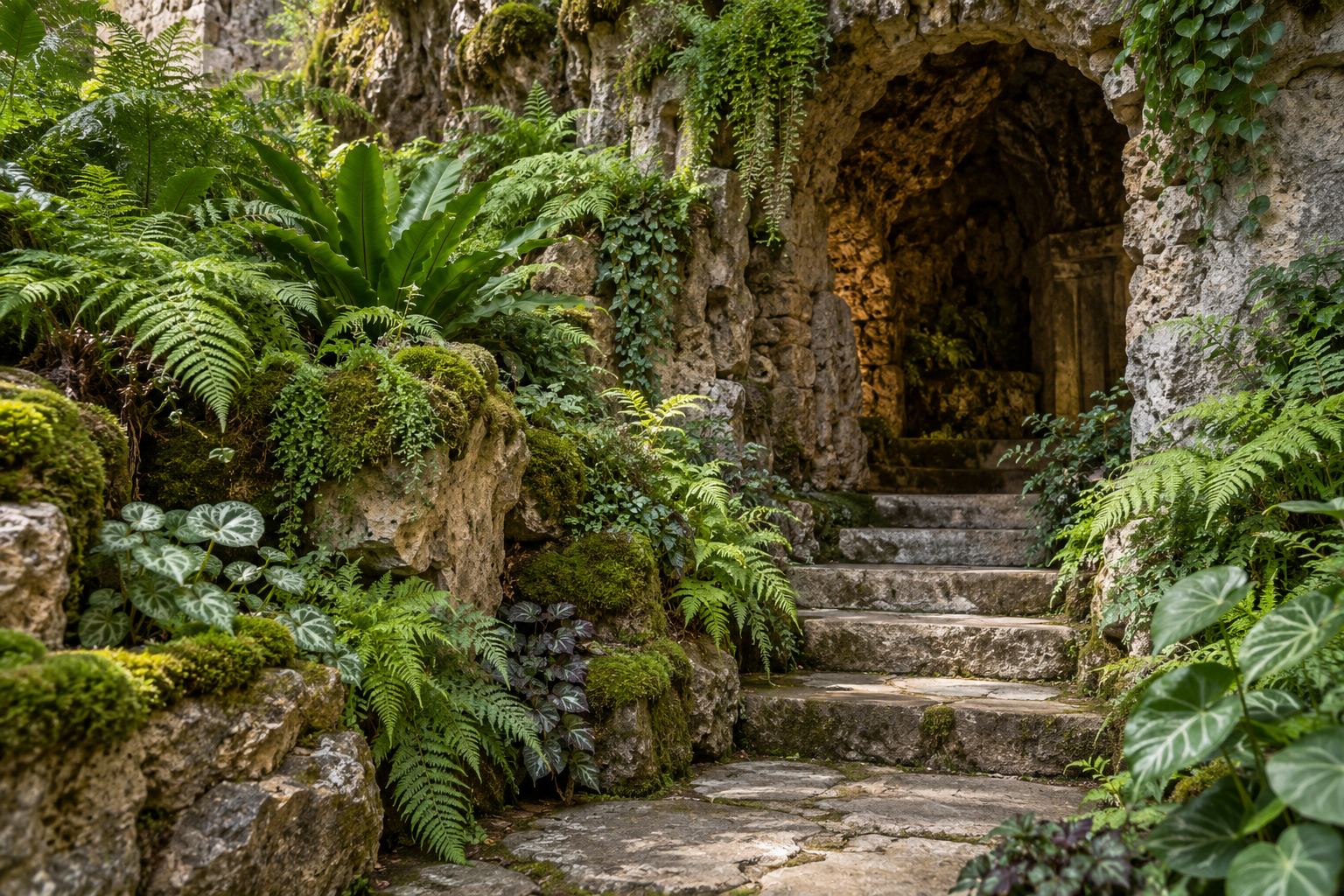
Ferns beside a shaded opening can make a grotto feel rooted in its landscape, but living surfaces need more than a location. Light, moisture, growing medium, drainage, and maintenance determine whether the planting can remain part of the composition. Planting & Living Surfaces explores vegetation around entrances, rock pockets, water edges, and sheltered retreats. Compare the visual roles of trailing foliage, broad leaves, fine grasses, and moss-like textures while keeping their growing requirements in view. A naturally damp cave entrance is not a universal model for a constructed enclosure with different light and water conditions. This collection helps garden owners and designers distinguish a planting idea from a planting arrangement. It also considers how growth changes views, access, and the balance between stone and vegetation. Plants can soften a boundary without covering every surface, and open areas may be essential for both visual clarity and care. Follow the planting through establishment, maturity, and seasonal change to understand how a living grotto setting develops, rather than judging success only by the photograph taken on installation day.
A: No. Light, moisture, roots, and species requirements must align.
A: No. Suitable biological conditions are necessary.
A: Growth changes access, views, and available space.
A: They may screen them visually while preserving usable access.
A: Yes. Splash and water chemistry can matter.
A: No. Its role and maintenance are different.
A: Open surfaces support composition and practical care.
A: Regional climate and species suitability require contextual knowledge.
A: Yes. Growth may justify adjustment.
A: Species, growing conditions, water management, access, and ongoing care belong together.