
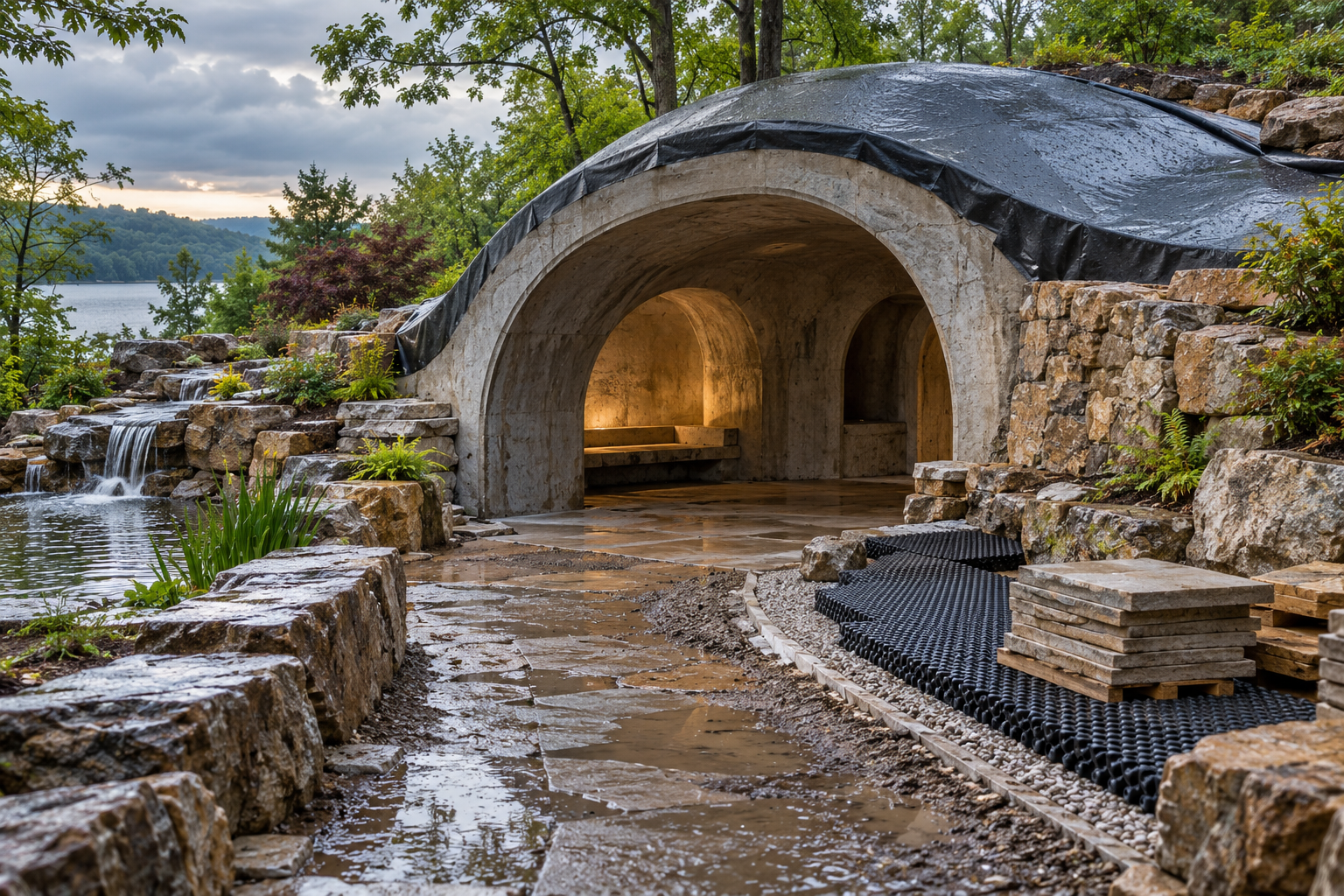
A drip inside a grotto may begin far from the spot where it appears. Rain can enter above the enclosure, splash can reach an exposed joint, and plumbing can leak behind a finished face. Moisture may then travel along a surface before becoming visible. Painting the stained spot treats the location of the symptom, not necessarily the route of the water.
Understanding waterproofing starts with separating those routes. The aim is to identify what should shed water, what should contain it, where incidental moisture can drain, and how the assembly can be inspected without dismantling the entire setting.
A: No. Water can travel before becoming visible.
A: No. Drainage, interfaces, plumbing, and condensation may require different responses.
A: No. Immersion and water chemistry can change material requirements.
A: Their location and construction become difficult to confirm after finishing.
A: Yes. Groundwater, runoff, drainage, and retaining conditions need assessment.
A: It is liquid water formed when vapor condenses under the surface conditions present.
A: Use a test method selected by the responsible specialist for that assembly.
A: Compatibility and drying behavior can change, so check the actual system.
A: Dates, weather, feature operation, locations, and photographs of changes.
A: It addresses an identified water route and the assembly details involved.
Route one: rain arriving from above
A grotto roof may look like a natural pile of rock while functioning as an exterior enclosure. Rain encounters horizontal pockets, ledges, joints, and penetrations. The decorative surface can slow or redirect water, but its appearance alone says nothing about the continuity of the water-control layer beneath it.
Follow a roof section from the highest exposed point to the intended discharge. Where does water leave? Does it pass over the entrance, behind a facing, or toward an adjacent wall? A design should make those destinations deliberate. Simply adding more surface sealant does not establish a drainage route.
Particular attention belongs at transitions: the grotto against a building, a pipe passing through the roof, or a change between materials. These are places where separate systems must join. Their details need to explain how continuity is maintained while accommodating the intended construction and movement.
Route two: water held or circulated by the feature
A waterfall introduces water from within the project. Its supply lines, distribution area, channels, and receiving basin have different duties from a roof exposed to occasional rain. A product suitable for one location is not automatically appropriate for continuous immersion or the chemistry of a pool.
Draw the intended wet boundary. If a channel carries water across the grotto roof, show which assembly contains that water and how it connects to the discharge. If spray regularly reaches a seating recess, that recess cannot be treated as though it experiences only dry interior conditions.
Access changes the consequences of a failure. A replaceable fitting behind a reachable panel is a different maintenance proposition from the same fitting permanently buried behind rockwork. Coordinate inspection and repair access while the water route is still visible on the drawing.
Route three: water arriving from soil or adjacent surfaces
Where a grotto backs into a slope or sits beside raised planting, moisture can arrive from outside the visible feature. Surface runoff and water in the ground require their own assessment. A dry-looking front wall does not explain what happens behind it after prolonged rain.
The design team should distinguish a freestanding enclosure from a retaining condition. Soil, drainage, groundwater, and structural demands can change substantially when the grotto also holds back earth. Decorative rockwork should not conceal the absence of a resolved retaining and drainage design.
Nearby paving and planting are part of this picture. Their finished levels and drainage routes can direct water toward or away from the enclosure. Review the surrounding landscape rather than stopping the water-management drawing at the grotto’s outline.
Route four: moisture that changes state
Not every damp surface indicates a liquid-water leak. Water vapor can condense when conditions at a surface reach the dew point. An enclosed, humid grotto therefore raises questions about surface temperatures, ventilation, and use, as well as waterproofing.
Condensation and leakage can coexist. A damp ceiling observed on a humid evening should not be assigned a cause solely from its location. Timing, weather, system operation, and the pattern of moisture help guide investigation. Where the cause is uncertain, assessment should precede selection of a treatment.
Five jobs that should not be collapsed into one coating
| Job | What the design must explain |
|---|---|
| Shed | How exposed surfaces direct water toward planned discharge points |
| Exclude or contain | Where a continuous water-control layer is required |
| Drain | How water reaching designated drainage spaces can leave |
| Accommodate | How joints and transitions handle expected movement |
| Inspect | How critical locations can be checked and serviced |
Read product claims in the context of the assembly
Terms such as water-resistant, waterproof, breathable, and immersion-rated describe different properties or intended uses. The relevant information is the manufacturer’s documented application, substrate preparation, compatible adjoining materials, exposure limits, and detail requirements. A broad label on a container cannot answer all of those questions.
Compatibility also matters over time. A later coating or repair compound may change how the existing assembly behaves or prevent another material from bonding. Keep the original specifications and installation records available so future work can be evaluated against what is actually present.
Use testing to answer a defined question
Before rockwork conceals critical layers, the project team should establish appropriate inspections and any specified testing. The method needs to suit the assembly and the question being investigated. Unplanned flooding or indiscriminate spraying can introduce water into places the system was never intended to contain it.
For an existing grotto, record when moisture appears relative to rainfall, waterfall operation, pool use, and weather changes. Those observations do not diagnose the cause, but they help distinguish possible routes. The most useful repair begins with a credible explanation of the path from entry to visible symptom.
Related Articles
Natural Stone, Sculpted Concrete, or GFRC: Comparing Grotto Rockwork
Compare natural stone, sculpted concrete, and GFRC grotto rockwork through appearance, support, joints, fabrication, and repair.
Sheet, Cascade, or Segmented Flow? Choosing a Grotto Waterfall
Choose sheet, cascade, or segmented grotto waterfalls by comparing water shape, splash, sound, viewing distance, and upkeep.
A Grotto Inspection Walkthrough: Changes to Notice and Record
Build a useful grotto inspection record with repeatable photographs, clear observations, water-pattern notes, and follow-up.